Spoiler: stop chasing them. You’re not Michael Phelps. They’re faster anyway.
Intro
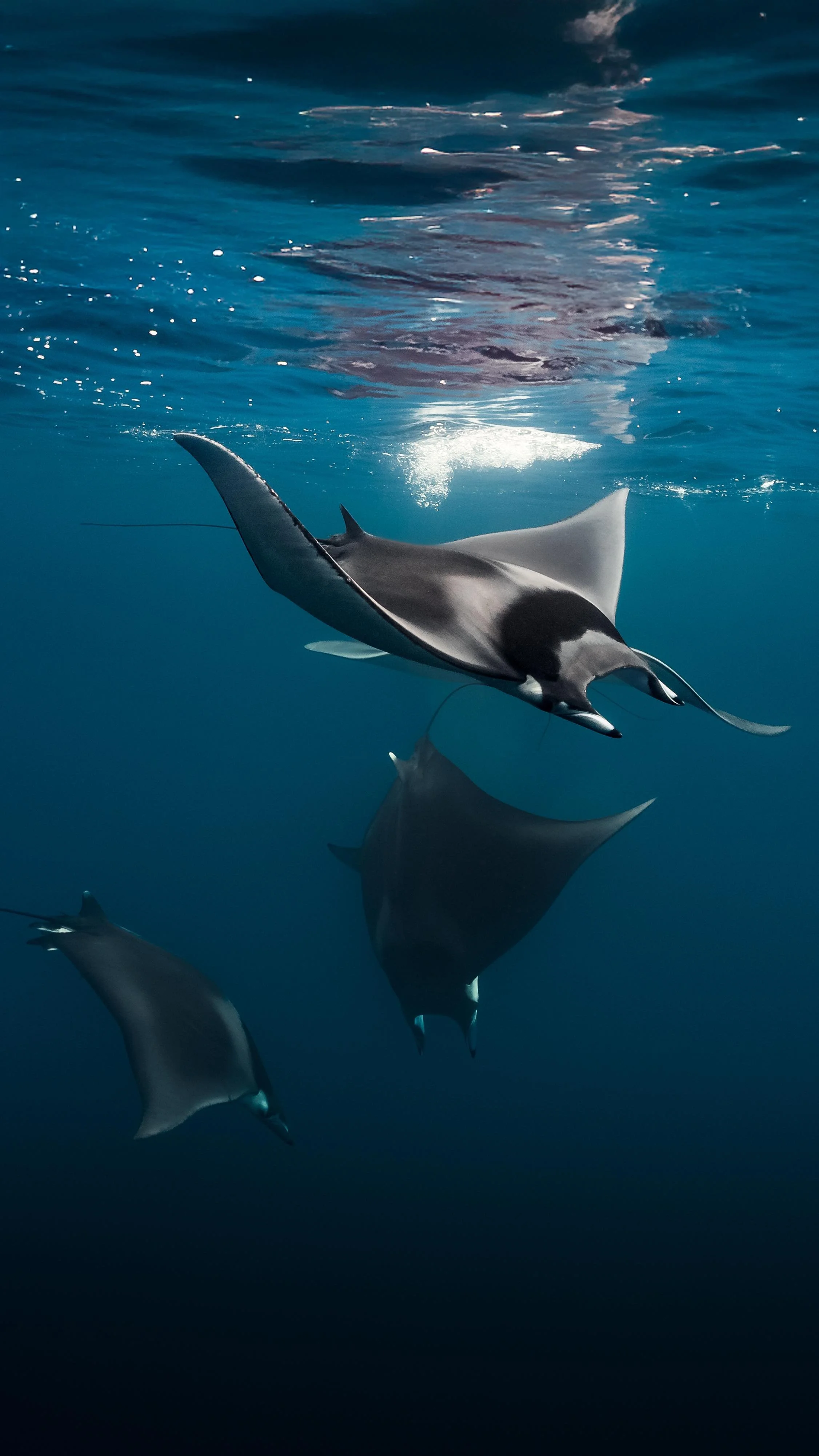
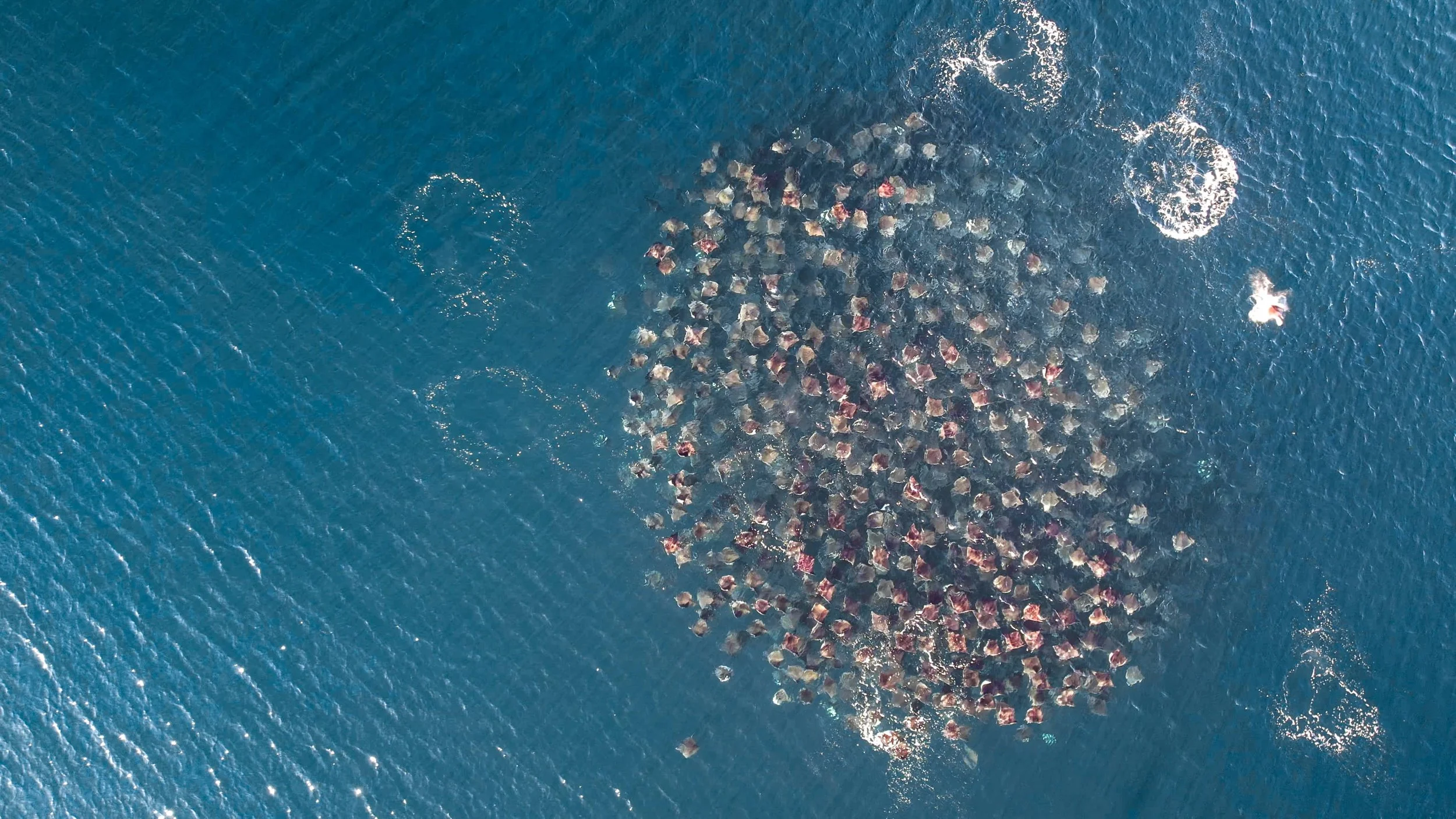
Here’s the thing nobody tells you about mobula rays: they can be incredibly shy. Yeah yeah, I know, you’ve seen the footage of divers surrounded by thousands of them, a tornado of wings and horns, and you’ve assumed the rays just kind of tolerate humans like it’s no big deal. They don’t. Every one of those viral clips is either the result of someone getting it exactly right with the rays being in a particularly mellow mood… or, more often than not, its the result of a forced unethical encounter of someone diving directly through the middle of the rays and the shot is slowed down and made to seem like the rays aren’t being split and trying to get away. Often it is unknown to many people that this is an unethical way of interacting, and most of the time that comes down to not being given a proper briefing on how to interact with the little flying tortillas - read our blog on how to choose a responsible operator. But, and a big but, other times people do already know that it’s not the right way to interact, and they still do it anyway, selfishly, to get the shot they want.
On the water in La Ventana during peak mobula season, I watch people get it wrong constantly. Big splashing entries. Aggressive fast swimming straight at the fever (a fever is the name of a group of rays). Chasing them from behind. And the rays just… leave. One moment there’s ten thousand of them 5m (15 feet) below you. The next, they’ve dove down to deeper water because you dove down on top of them, and you’re floating there in an empty blue, wondering what just happened.
The ones who get it right? They get the hour-long encounter. The kind where the fever moves around you, under you, and you get footage that looks unreal because it is unreal! It’s the actual encounter you want rather than a performance pulled out of avoidant animals.
Over the years I have personally seen with my own eyes the mobulas getting more avoidant as the years go on. More pressure from higher amount of tourists not knowing the correct way to interact is a huge factor for this, in my honest opinion. We must protect the animals and this activity so they don’t come to view humans as a nuisance, otherwise we may lose the chance to interact with them altogether.
This is an extreme case, but they definitely have changed behaviour since I first ever saw them.
So. Here’s how to actually do it.
First: understand what a mobula ray is (and isn’t)
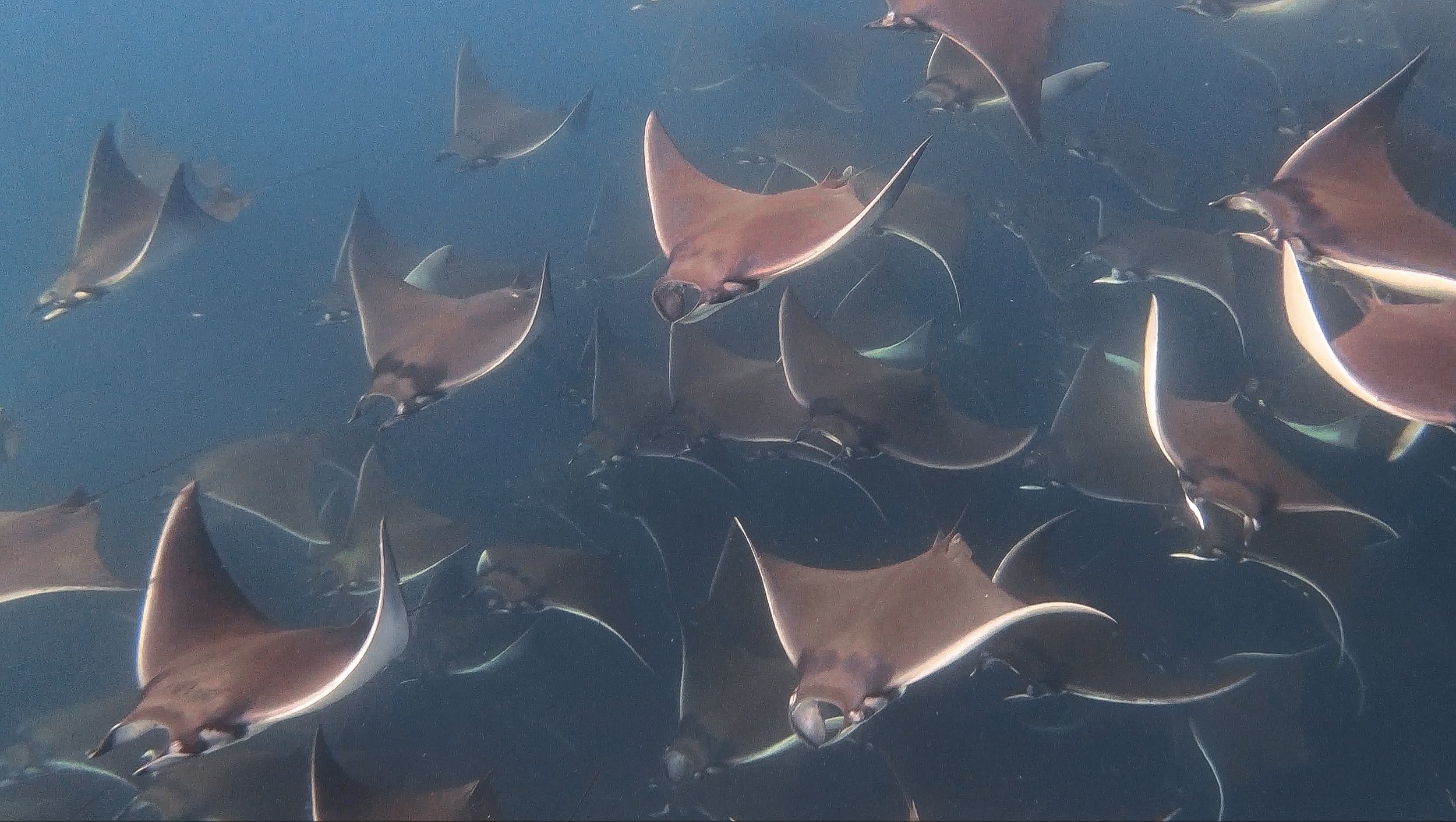
Mobula rays are filter feeders. They eat plankton, not you. They are not dangerous. They don’t have a barb like their sting ray cousins, they don’t bite, and despite being called “devil rays” because of the weird horn looking cephalic lobes on their heads they’re about as threatening as a pigeon in Trafalgar Square (just don’t look up with your mouth open… speaking from experience!)
But they are wild animals in the middle of an extraordinary seasonal behaviour. The Sea of Cortez fever aggregations happen because the rays are feeding, mating, or socialising in ways we still don’t fully understand. They’re vulnerable to disturbance. Every unnecessary spook costs them energy they came here to save and spend on breeding. Multiply that across hundreds of tourists per week and you can imagine the impact.
Did you know that the Oceanic manta ray has the biggest brain to body ration of any animal? And they passed the mirror test, meaning they can recognise themselves when a big mirror was placed in front of them in the water. Yes, let that sink in, so mobula rays as a genus are some of the more intelligent species on the planet.
So if they constantly see boats coming in too fast, humans chasing and diving down through them and lots of noise and splashing… they are going to link humans with annoyance or danger. Which, to stress even more, we have already seen a change in the last few years :(
Which is why the “correct way” to interact with them isn’t just about getting the best photo. It’s about not being the reason an already-threatened species has a worse breeding season.

The guidelines that actually work
After doing this for years, here’s what I’ve learnt. None of this is complicated. Most of it is the opposite of what your instincts tell you.
Stop splashing. Enter the water like you mean it, quietly
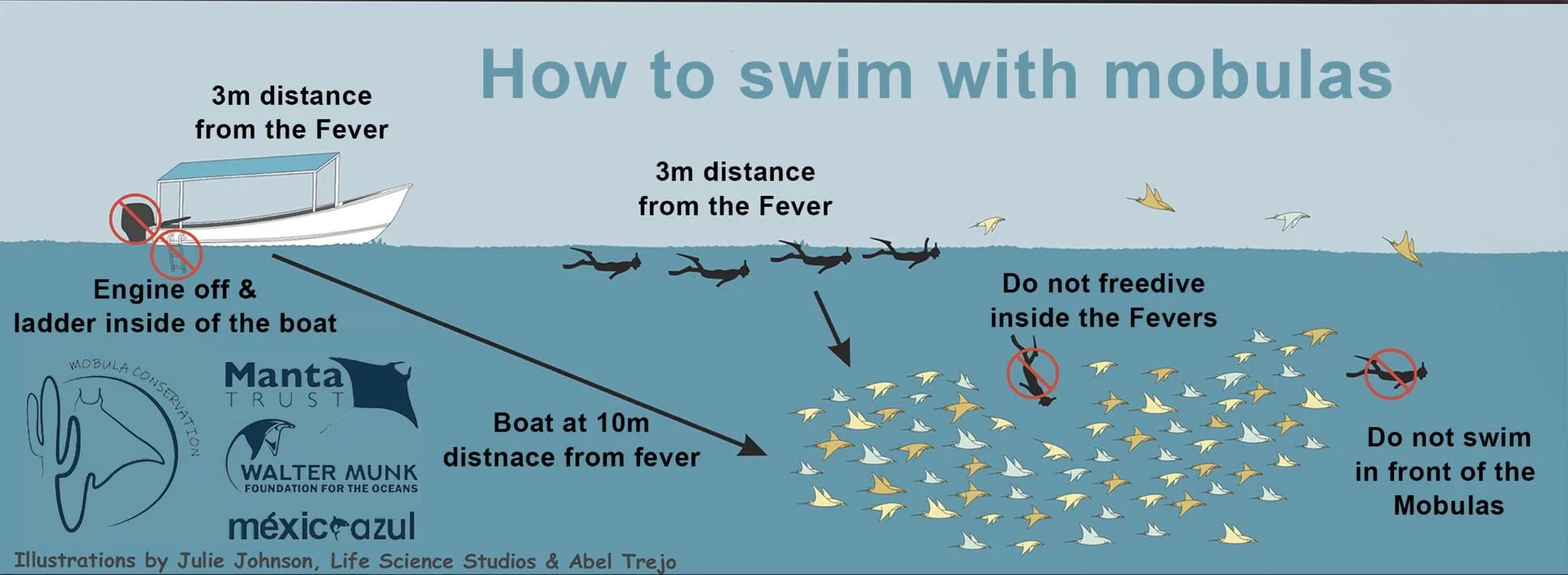
The entry is where most people blow it. They sit on the edge of the boat, they see the fever, they get excited, they launch themselves over the side with the subtlety of a sack of potatoes. Below the surface, it can sound like a bomb going off. Mobulas have excellent pressure-wave detection — they feel you land before you see them.
Slide in. Don’t jump. NEVER do a scuba style backwards roll. Minimise splash. If you want to practise, practise before reaching the mobula rays. Don’t practise on the rays.
Approach and position yourself from the side
This is really important. Rays have their eyes positioned on the side of their head and cannot see well directly in front of them or behind. So staying to the side in a calm manner allows them to see you. One of the best positions is staying slightly in front of them to the side which shows that you are not chasing behind like a predator or want to eat them.
We encourage not to dive down unless the fever is very calm, and we only allow diving once the guide has tested themselves to see if the diving changes the behaviour of the rays. If it does, no one dives, if it doesn’t, then we allow people to dive one by one but only to the side of the fever, and at least 5m away. You should never dive down on top of the rays, or dive from below up through the Rays. Predators often attack from below or behind, so if they see this approach they are naturally going to think you might be a threat. Which takes me onto the next point.
Don’t chase them. You will lose
Mobulas can outpace you without trying. A relaxed fever moves slowly; a spooked fever disappears into the blue. If you see the rays starting to move away from you, stop swimming. Stop completely. Hold still. If they’re comfortable, they’ll often come back. If you chase, they will not come back.
This is the hardest rule psychologically. Everyone wants to get closer. Your instinct will tell you to finish the race. But the mobulas don’t want a race, and you are not faster than them. I promise.
The goal is to make the mobula rays feel comfortable, once they do, they will often rise closer to the surface of the water for a much better view of them.
Stay calm. Don’t flap
Uncontrolled movement is a signal. In the ocean, things that thrash around are either injured or attacking. Neither is reassuring if you’re a shy ray. The best in-water position for a mobula encounter is a quiet, neutral drift, body turned to the side so that your fins stay under the water and not splashing at the surface, hands at your sides, breathing slow if you’re snorkelling at the surface. The smaller the group can be the better, so try to stay close and not too spread out where possible. Basically, as smooth and quiet as you possibly can.
Don’t touch. Ever
This should be obvious, but… humans, enough said. If you’re lucky enough to come across a calm fever of rays that literally surfaces around you within an arms length some people feel the need to stroke the rays. Please don’t. Mobulas have a thin mucus coating that protects them from parasites and bacterial infection. Your hand strips it off. So do your fins if you brush against them. A single touch might not kill a ray, but it could cause damage, and at scale across the hundreds of tourists who will interact with the fever that season, the harm can add up.
Also: mobulas are surprisingly dense muscle. The little ones are roughly the size of a large dog, the big species can have wingspans of 3+ metres, and if you touch a ray that doesn’t want to be touched, you’ll discover they can hit back without noticing.
Watch the behaviour. Read the signals
This is the skill that separates someone who gets the hour-long encounter from someone who gets the vanishing fever.
Signs a fever is relaxed:
Moving slowly, in formation, changing direction gently
Individuals peeling off to feed on their own, then rejoining
Rays rolling sideways, showing bellies (feeding behaviour)
Close spacing with calm synchronised movement
Signs a fever is stressed:
Speed increasing, tight formation compressing further
Whole fever suddenly changing direction together
Rays breaking off and diving down repeatedly
The fever visibly dropping in the water column — going deeper
Fever splits into multiple groups.
If you see the stress signs, back off. Give them space. They may recover and come back up, or they may leave the area entirely. Either way, pushing harder now will just turn a bad moment into a vanished moment.
Trust the guide
This is the one I always tell guests before we get in the water. If the guide says “not yet,” they mean it. If they say “get out of the water now,” they also mean it. Guides on good operators have watched hundreds of fevers, across many seasons, in many conditions. They can tell when a ray is about to spook before you can. They can also tell when the fever is relaxed enough that a careful entry will yield a genuinely long encounter.
On budget tours, guides (if there even is one) may not have this experience. Which is part of why operator choice matters — see our how to choose a responsible operator blog. A good guide turns the same ocean into a completely different experience. In the blog we talk about how animals behave differently in each country. Last year, we had a guest that deliberately disobeyed one of our guides clear instructions not to dive down onto the rays. She dove down, the mobulas changed their behaviour. He said to her, “Please, don’t dive down, I said in the briefing no diving down until I say” They tried for a second go, she dove down again. The Mobulas left. When asked again why she did that, she responded that she has dove with rays in the Maldives many times so it was ok to do so. This is a prime example of someone taking an animal from a different location (they were also Eagle rays, a complete different species) and thinking that you know better than a guide that does this day in day out with the rays. Please trust the guide, they are not putting these rules in to stop you having fun, it’s the opposite! They want you to have the best experience as possible and doing what they say gets you closer than if you don’t.
True Story: Last season we were waiting our turn on a fever as another boat approached first (taking turns and not having a max of 2 groups on a fever is crucial too. We try to keep only one group per fever but sometimes other groups are invited to join if the fever is calm). The guide was in the water first trying to locate the mobulas, great, I looked on the boat and the guests were looking at the guide, and then each other slightly confused, none of them had their snorkel gear on. The guide put his hand up in the air to signal the group that he had found the rays. The group still looking confused but excited. They started quickly putting their snorkel gear on, apart from one bloke, who literally climbed onto the side of the boat with his fins in his hands and leaped into the water with a huge splash, then frantically put his fins on in the water and swam towards the rays as if it was an olympic 100m freestyle. The rest of the group plonked in sporadically, making a huge presence in the water. Needless to say that within 30 seconds the mobula rays had left.
“Ok gang, that is exactly what NOT to do! ”
I’m not trying to put down my fellow peers, but that whole interaction (if you can call it that) was the result of either a bad or no brief, lack of organisation in the boat, and not understanding the animals. The sad thing is, this wasn’t a one off. We see similar cases on 99% of days on the water with mobula rays.
Following these guidelines will give you a much longer, more ethical and closer encounter than if you don’t follow them. It also is much better for the mobula rays that are on the IUCN red list as vulnerable. Interrupting them during feed and breeding season can reduce the population further…
…and nobody likes a c*ck block (or a clasper block!!) So don’t be one!
Special note for photographers
If you’re bringing a camera, a few extra things:
Turn off the strobe or flash when you’re close.
Actually, just don’t use it at all for mobulas (and most animals actually). They have good vision, bright flashes startle them, and your ambient-light footage will probably be more beautiful anyway.
Use a wide-angle lens for the fevers.
Mobulas are fevers can be enormous, and not getting the full scale can ruin the shot. Go wide. Get the scale.
Use a zoom for close details.
Mobulas have really cool cephalic lobes and eyes, zoom in for the fine details.
Don’t chase the shot.
Whatever shot you were picturing, the fever will show you a better one if you let them come to you. The shots that go viral aren’t the ones chased. They’re the ones gifted.
What to do when it goes “wrong”
Sometimes, despite doing everything right, the rays leave. Wind comes up, the water shifts, a larger predator passes through, or the fever just decides it’s time to go somewhere else. This isn’t a failure. It’s the ocean.
What you absolutely shouldn’t do is chase them to the next spot. Get back on the boat, let the guide decide where to try next, and accept that the encounter ended. The rays aren’t yours to hold onto. They were going to leave eventually. You can’t extend the encounter through willpower. There’s plenty more fish in the sea…. and dolphins, whales, sea lions, and more… All of which are reasons why this trip is a sea safari, not a guaranteed mobula swim. More on that in our sea safari diversity piece.
Universal principles (worth knowing for any marine wildlife)
While we're here, worth flagging: most of these rules apply to every marine animal you'll encounter, not just mobulas. Quiet entries. No chasing. Read the behaviour. Don't touch. Trust the guide.
We'll cover this properly in a dedicated how to correctly interact with marine life piece across all the species we work with — gray whales, humpbacks, dolphins, sea lions, whale sharks. Each species has its own quirks, but the underlying philosophy is always the same: animals decide the terms of the interaction. Your job is to show up quietly and not f*uck it up.
FAQ
Are mobula rays dangerous?
No. They’re filter feeders, they don’t have barbs (unlike stingrays), and they have no interest in interacting with humans beyond “that thing is in my way.”
Can I freedive with them?
Yes, but only when conditions and the behaviour allow it. Approach from the side, never directly above or below. Your guide will brief you on each encounter.
What’s the best camera setup for mobula rays?
Wide-angle lens, ambient light (no flash), stable short clips if filming. A DJI Osmo or equivalent with a wide FOV handles this well.
What if I don’t feel confident in the water?
Tell your guide. There’s no shame in staying on the boat for an encounter if you’re not ready. And watching the rays try to fly is often more fun anyway!
What’s the single most important rule?
Stay calm and move smooth. If you can stay calm in the water, the rays will come closer than you’d ever expect. Everything else flows from that.
JOIN US!!
If you want to see what a relaxed fever looks like in person, and more importantly, how to share the water with them the right way, join our Mobula Ray Migration expedition April through June, 7-day recommended, small groups, experienced guides who'll brief you properly before every water entry. Also, our La Ventana Snorkel Tourfor day trips. Multiple days always recommened for the highest chance of seeing more animals.
Check out our Wild Encounters on Instagram